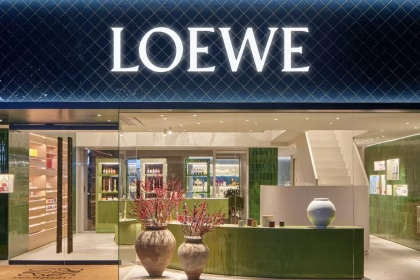


- 1. Loewe (Former Creative Director: Jonathan Anderson)
- 2. Lemaire (Designers: Christophe Lemaire & Sarah Linh Tran)
- 3. Charles Jeffrey LOVERBOY (Designer: Charles Jeffrey)
- 4. Eckhaus Latta (Designers: Mike Eckhaus & Zoe Latta)
- 5. Maison Margiela (Creative Director: John Galliano)
- 6. Ludovic de Saint Sernin (Designer: Ludovic de Saint Sernin)
- 7. Palomo Spain (Designer: Alejandro Gómez Palomo)
- 8. Craig Green (Designer: Craig Green)
- 9. Dries Van Noten (Designer: Dries Van Noten)
- 10. Studio Nicholson (Designer: Nick Wakeman)
JW Anderson is a pioneer of contemporary gender fluidity, renowned for his cross pollination of menswear and womenswear. His work is defined by thought provoking silhouettes, subverting traditional masculine and feminine tropes to create a new, inclusive aesthetic. For fans of his style, the best alternatives are brands that prioritize intellectual design, experimental forms, and a disregard for the gender binary.
The following ranking evaluates brands based on their innovation in silhouette, their commitment to gender neutral design, and their ability to blend diverse sartorial elements.
| Rank | Brand | Key Innovation | Aesthetic Focus |
| 1 | Loewe | Surrealist craft & form | High art, avant garde luxury. |
| 2 | Lemaire | Fluid, unisex tailoring | Quiet, intellectual sophistication. |
| 3 | Charles Jeffrey LOVERBOY | Queer couture & clubwear | Radical, maximalist gender bending. |
| 4 | Eckhaus Latta | Deconstructed silhouettes | Raw, urban, and non binary. |
| 5 | Maison Margiela | Conceptual deconstruction | Intellectual and subversive luxury. |
| 6 | Ludovic de Saint Sernin | Eroticized femininity in men | Poetic, sensual, and gender less. |
| 7 | Palomo Spain | Historical gender fluidity | Flamboyant, romantic masculinity. |
| 8 | Craig Green | Structural, sculptural forms | Conceptual and utilitarian unisex. |
| 9 | Dries Van Noten | Eclectic print & femininity | Masterful cross gender styling. |
| 10 | Studio Nicholson | Modular, voluminous cuts | Clean, architectural unisex basics. |
1. Loewe (Former Creative Director: Jonathan Anderson)
While JW Anderson (the label) is more experimental and personal, Loewe applies the same cross pollination philosophy to a century old luxury house. You will find the same playful use of volume, surrealist details (like the famous “pigeon” bag), and a constant dialogue between masculine and feminine craft traditions.
2. Lemaire (Designers: Christophe Lemaire & Sarah Linh Tran)
Lemaire offers a “quiet” version of JW Anderson’s gender fluidity. Their collections are almost entirely unisex, featuring fluid trousers, draped shirts, and modular outerwear that fit both men and women seamlessly. For those who love the intellectual side of JW Anderson but prefer a more muted, wearable color palette, Lemaire is the definitive choice for sophisticated, gender neutral tailoring.
3. Charles Jeffrey LOVERBOY (Designer: Charles Jeffrey)
If you appreciate the radical and thought provoking side of JW Anderson, Charles Jeffrey LOVERBOY is the high energy alternative. Hailing from the London club scene, Jeffrey creates “queer couture” that aggressively breaks down gender barriers. His silhouettes are often extreme, incorporating corsetry, ruffles, and avant garde knitwear, to challenge the very definition of masculinity.
4. Eckhaus Latta (Designers: Mike Eckhaus & Zoe Latta)
Eckhaus Latta is the American master of deconstructed, non binary fashion. Their approach to silhouette is raw and intuitive, often using “real people” of all genders and body types to showcase their collections. Their use of unconventional knits and “off” proportions resonates with JW Anderson’s early work, offering a more urban, underground take on the cross pollination of styles.
5. Maison Margiela (Creative Director: John Galliano)
Maison Margiela has long been the gold standard for subverting sartorial norms. Under John Galliano, the house has leaned further into “gender less” Artisanal collections. Their “Recicla” and deconstructed tailoring lines often feature menswear elements repurposed for feminine silhouettes and vice versa, maintaining a level of intellectual depth that mirrors JW Anderson’s design philosophy.
6. Ludovic de Saint Sernin (Designer: Ludovic de Saint Sernin)
Ludovic de Saint Sernin focuses on the eroticized intersection of masculinity and femininity. His work often utilizes traditionally “feminine” materials, like Swarovski crystals, sheer silk, and lace, to create garments for men. For a fan of JW Anderson’s more daring and sensual pieces, de Saint Sernin offers a poetic and unapologetically queer exploration of the human form.
7. Palomo Spain (Designer: Alejandro Gómez Palomo)
Palomo Spain brings a sense of historical romance to gender fluidity. Alejandro Palomo uses the codes of Spanish couture and historical dress, heavy silks, embroidery, and dramatic ruffles, to dress men in a way that is traditionally perceived as feminine. It is a flamboyant and beautiful alternative to the “new masculinity” that JW Anderson often explores.
8. Craig Green (Designer: Craig Green)
While less focused on “feminine” tropes, Craig Green is a master of the gender neutral silhouette. His work is architectural and sculptural, often using straps and quilting to create forms that exist outside of traditional gendered clothing. His ability to create “thought provoking” shapes that feel both utilitarian and conceptual is highly reminiscent of JW Anderson’s structural innovations.
9. Dries Van Noten (Designer: Dries Van Noten)
Dries Van Noten is a master of stylistic cross pollination. He often incorporates feminine floral prints, delicate fabrics, and soft tailoring into his menswear collections. While his silhouettes are often more grounded than Anderson’s, his ability to blend masculine and feminine aesthetics through color, texture, and layering makes him a favorite for those who enjoy a nuanced, artistic approach to gender bending.
10. Studio Nicholson (Designer: Nick Wakeman)
Studio Nicholson focuses on volume and modularity. Founded by Nick Wakeman, the brand creates an “architectural wardrobe” where the garments are designed to be shared across the gender spectrum. Their focus on precise construction and voluminous, shrunken, or exaggerated proportions provides a clean, contemporary alternative to JW Anderson’s more avant garde experiments.