- Who is partnered with whom, at a glance
- Meta proved the strategy, and the numbers are not close
- What Warby Parker actually brings: 337 stores and a prescription supply chain
- Gentle Monster, Gucci, and the leverage fashion now holds
- Where this leaves the smart-glasses race, and what to watch
- Future Outlook
Meta and EssilorLuxottica sold more than 7 million smart glasses in 2025, roughly tripling the prior year. At Google I/O 2026, Google and Samsung answered with two frames designed not in-house but by Warby Parker and Gentle Monster. Even Gucci is now on the platform, with a 2027 launch. The hardware was never the problem. The face was.
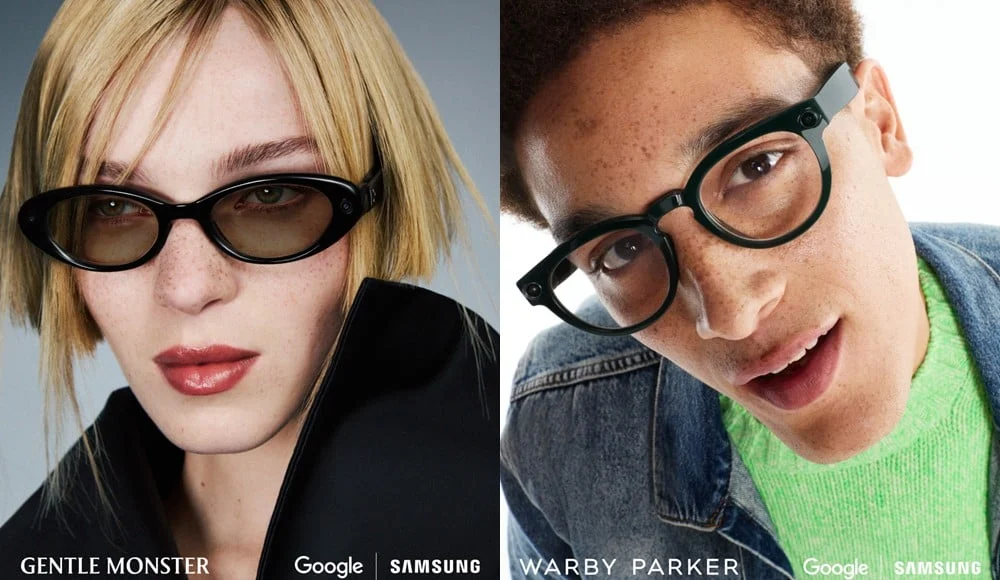
On May 19 to 20, 2026, at Google I/O 2026, Google and Samsung gave the first public look at their Intelligent Eyewear, the first true glasses to run Android XR. The headline feature was not the Gemini assistant inside. It was the names on the temples. The two debut styles were created with eyewear partners Gentle Monster and Warby Parker, not designed in a Mountain View hardware lab. Audio-first glasses launch this fall, with display glasses to follow. No price has been announced.
The most powerful AI company in the world, partnered with the largest consumer-electronics manufacturer in the world, chose to lead its smart-glasses reveal with two fashion brands. That is not a marketing flourish. It is an admission. The thing that has killed every smart-glasses launch for a decade was never the silicon. It was whether anyone would actually wear the result in public. And on that question, Google has decided it cannot win alone.
Who is partnered with whom, at a glance
The smart-glasses market has organised itself into a small number of tech-and-fashion pairings. In each case, the technology company supplies the compute and the AI, and the fashion company supplies the thing people are willing to put on their face.
| Tech platform | Fashion / eyewear partner | Status | Notes |
| Meta | EssilorLuxottica (Ray-Ban, Oakley) | Shipping since 2023 | 7M+ units sold in 2025; partnership extended to 2030 |
| Google / Samsung (Android XR) | Warby Parker | Audio glasses this fall | Google committed up to $150M to the partnership; first Android XR eyewear partner |
| Google / Samsung (Android XR) | Gentle Monster | Audio glasses this fall | Luxury-leaning Korean eyewear brand; second named partner |
| Google (Android XR) | Gucci (Kering) | 2027 launch indicated | Confirmed by Kering leadership; luxury price tier |
| Google (Android XR) | XREAL (Project Aura) | 2026 | Wired developer-oriented XR glasses; not a fashion frame |
Source: Samsung Newsroom and Google Android XR blog (May 19, 2026); EssilorLuxottica FY2025 results (February 11, 2026); Warby Parker / Google I/O 2025 announcement; Kering capital markets day (April 16, 2026). Compiled by author.
Why Google Glass failed, and why it was never about the chip
To understand why Google is now leading with fashion, look at the company’s own history. Google Glass launched to developers in 2013 at $1,500 and was effectively dead as a consumer product within two years. The post-mortems are consistent, and they have almost nothing to do with the technology. The device was banned from bars, restaurants, cinemas and casinos over privacy concerns, and wearers were mocked as “Glassholes” for the social discomfort the camera created. The problem was that Glass looked like a piece of technology strapped to a face, and people did not want to be seen wearing it or standing next to it.
Even Larry Page, Google’s co-founder, later conceded the point, admitting the company had always doubted people would want to wear the glasses because they were intrusive rather than invisible. There was also a specific, instructive omission: the original Glass had no real answer for the hundreds of millions of people who already wear prescription lenses. A face computer that ignores how most people actually use eyewear was never going to reach scale. The lesson the industry took away was blunt. Smart glasses are a fashion and optical problem first, and a computing problem second.
Meta proved the strategy, and the numbers are not close
The brand-led approach is not a hypothesis. It is already the highest-volume success in the category. Meta partnered with EssilorLuxottica, the world’s largest eyewear maker and owner of Ray-Ban and Oakley, and the result reset the market. EssilorLuxottica reported that it sold more than 7 million smart glasses in 2025, more than tripling the prior year, up from the 2 million units sold across 2023 and 2024 combined. Smart glasses became the dominant driver of the company’s wholesale growth in the second half of the year, and Meta and EssilorLuxottica are reportedly discussing doubling production toward 20 million units.
The reason for the success is the reason it matters to retail. The Ray-Ban Meta glasses worked because they looked like Ray-Bans, not like a prototype. Industry coverage estimates Meta now holds the dominant share of the smart-glasses market, and that lead is built on the strength of the Ray-Ban brand, not the Meta brand. The technology is, broadly, available to everyone. The brand that makes people comfortable wearing a camera on their face is not. That asymmetry is the entire competitive moat, and it sits with the fashion house, not the platform.
What Warby Parker actually brings: 337 stores and a prescription supply chain
This is where the retail lens sharpens the story. Warby Parker is not a hardware company and it is not, strictly, a luxury house. It is a 16-year-old direct-to-consumer optical retailer with 337 retail stores across the U.S. and Canada, an in-house prescription-lens operation, eye exams, vision tests, and insurance integration. Glasses at Warby Parker start at $95. What it offers Google is not styling alone. It is the optical and retail infrastructure that Big Tech does not have and cannot quickly build: the ability to fit a prescription, the physical stores to try frames on, and a customer base that already trusts the brand to put something on their face every morning.
Google has put real money behind that. Warby Parker confirmed in May 2025 that Google committed up to $150 million to the partnership, structured as $75 million toward product development and a further $75 million in equity tied to milestones, and named Warby Parker its first Android XR eyewear partner. That is a substantial commitment to a company whose core product sells for under $100, and it tells you how Google values the distribution and optical capability rather than the frames themselves. The debut frame, per Warby Parker, is built from ultra-lightweight nylon in a custom dark green, with the technology integrated into the temple.
Gentle Monster, Gucci, and the leverage fashion now holds
If Warby Parker is the access tier, Gentle Monster is the cultural tier. The Korean eyewear brand is known for its experiential retail and its standing among younger luxury consumers, and Google chose it to give the platform a fashion-forward identity that Warby Parker, by design, does not carry. Founder Hankook Kim framed the brief plainly, saying intelligent eyewear should feel as emotionally expressive as it is technologically advanced. Two brands, two aesthetics, two price points, one platform.
Then there is the move that proves the trend has reached the top of the market. Kering has confirmed that Gucci is developing Android XR smart glasses with Google, with a 2027 launch indicated by Kering leadership. That is significant for two reasons. First, it puts a true luxury house on the same platform as a $95 optical brand, which means Android XR can span price tiers in a way no single-brand approach can. Second, it places Kering in direct competition with EssilorLuxottica, whose Meta partnership now runs to 2030, opening a luxury front in a market that has so far been mass and premium. The common thread across Meta, Google and Samsung is unmistakable: every credible smart-glasses push now rides on a fashion brand. The technology companies are the ones seeking partners.
Where this leaves the smart-glasses race, and what to watch
First, whether Google’s multi-brand strategy can out-manoeuvre Meta’s single deep partnership. Meta has one eyewear partner and a two-and-a-half-year head start with more than 7 million units in the field. Google’s bet is that an open platform across Warby Parker, Gentle Monster and Gucci can cover more price points and style identities than one exclusive relationship. The audio-first glasses arriving this fall are the first real test of whether breadth beats depth.
Second, the price and the display question. The Android XR platform is designed for two device tiers: audio-only glasses and, in a later phase, display glasses with an in-lens screen. These are distinct products on different timelines. Warby Parker’s fall 2026 launch is audio-only — no display, no AR overlay, just speakers, microphones, cameras and Gemini inside a familiar frame, with multiple optical and sun styles supporting prescriptions. The display tier is a separate, later product and the natural home for the Gucci partnership targeting 2027. Meta’s current display model, the Ray-Ban Display, lists at $800 — a useful benchmark for where the in-lens tier may land. No pricing has been announced for any Google/Samsung product, which is itself worth noting.
Third, the retail and distribution mechanics that RetailBoss readers should watch most closely. Both Warby Parker and Gentle Monster have already launched dedicated Intelligent Eyewear sign-up pages, which means the brands, not just the tech companies, own the customer relationship and the pre-launch demand.
The open question is where these sell: through Warby Parker’s 337 stores and optical channel, through Gucci boutiques, through carrier and electronics retail, or all of the above. Whoever controls the point of sale controls the prescription attach, the fitting, and the repeat customer. On current evidence, that is the fashion and optical side, not the platform.
Future Outlook
The takeaway for retail is the inversion of the usual narrative. The story of smart glasses is not technology disrupting fashion. It is technology discovering it needs fashion’s stores, supply chains and social licence more than fashion needs technology’s chips. Google Glass had the better engineering pedigree and no brand to carry it, and it failed. Ray-Ban Meta had the brand, and it sold millions. Google has clearly learned the lesson. The names on the temples are the product.