Inside INDITEX Entire Brand Portfolio Serving Across 200 Markets
INDITEX runs one of fashion’s most finely tuned brand ecosystems, using eight banners to cover everything from teen streetwear to premium tailoring while keeping most of
Inside INDITEX Entire Brand Portfolio Serving Across 200 Markets
INDITEX runs one of fashion’s most finely tuned brand ecosystems, using eight banners to cover everything from teen streetwear to premium tailoring while keeping most of the value creation centered on ZARA. The group now generates around€38.6 billion in annual sales across5,563 stores and more than200 markets worldwide, with each concept playing a specific role in the portfolio.
Credit: Jeanel Alvarado
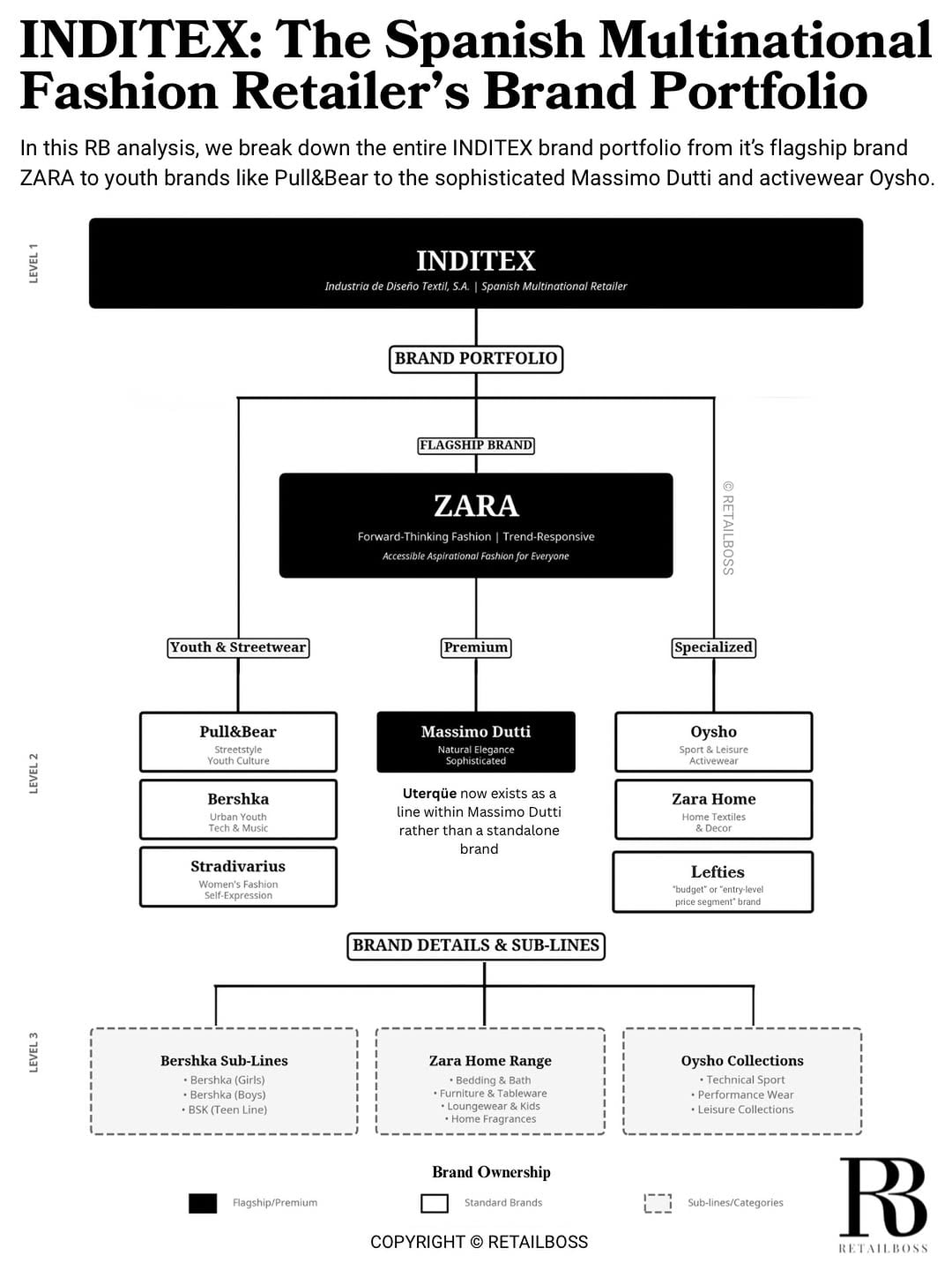
At the center of the infographic, ZARA anchors the system as the flagship, delivering about€27.8 billion in sales—roughly72% of group revenue—and around2,150 stores when ZARA and ZARA Home are combined. Youth banners Pull&Bear, Bershka, and Stradivarius flank it on the streetwear side, while Massimo Dutti covers elevated classics, and Oysho, ZARA Home, and Lefties handle active, lifestyle, and value, respectively, reducing cannibalization by keeping each brand’s style, price point, and target age band clearly defined.
Collectively, the non‑ZARA labels add meaningful scale. In…
2024, Bershka €2.93B, Pull&Bear €2.47B, Stradivarius €2.66B, Massimo Dutti €1.96B and Oysho €0.83B account for roughly a quarter of group sales, giving INDITEX diversification without diluting its focus on fast, trend‑led fashion.
The store network mirrors those roles: about 854 Bershka, 835 Stradivarius, 800 Pull&Bear, 528 Massimo Dutti, and 396 Oysho locations give each concept enough presence to matter globally while keeping ZARA visibly dominant.
Zooming out, the infographic makes it clear how INDITEX uses this ladder of brands to sit across the fashion pyramid: Lefties pushes hard into ultra‑value to compete with platforms like Shein, youth chains chase Gen Z trends, and Massimo Dutti and ZARA Home speak to older, higher‑spending customers who want quieter, more elevated products.
With group sales up 7.5% year on year and gross margin at 57.8%, the portfolio looks less like a collection of overlapping chains and more like a coordinated engine designed to capture nearly every fashion spend between value and premium.
Members-only article
Unlock the rest of this story
Join free to keep reading RetailBoss analysis coverage, industry analysis, and market intelligence.
Full article access
Industry analysis
Free account
Free access. No credit card required. Your account is created after you verify your email.
Discussion
0 Comments
No comments yet
Start the conversation
Share your take on this story and help shape the discussion.
Discussion
0 Comments
No comments yet
Start the conversation
Share your take on this story and help shape the discussion.
Sign in to join the discussion.