The Beauty Merger That Almost Remade the Industry, And Why It Fell Apart

Despite strong performance, Estée Lauder and Puig faced challenges, leading to a decline in their financial standings. The beauty industry is experiencing significant growth, with APAC showing notable expansion.

Jeanel Alvarado
By
Jeanel Alvarado
Jeanel Alvarado is a marketer and retail strategist, leveraging 15+ years of cross-disciplinary expertise in retail, e-commerce, technology, consumer and shopping trends. She is the former...
6 Min Read
The Beauty Merger That Almost Remade the Industry, And Why It Fell Apart

For exactly 59 days, the prestige beauty world watched two of its most storied names contemplate a union that would have created a $40 billion giant capable of challenging L’Oréal. Then, on May 21, 2026, Estée Lauder and Puig announced they had terminated discussions. No deal. No explanation. Just a terse joint statement and a stock market verdict that told the whole story: Estée Lauder surged 10–13%, Puig plunged 15%.

The divergent reaction reveals something important about what this deal actually was, and what it wasn’t.

What Was on the Table

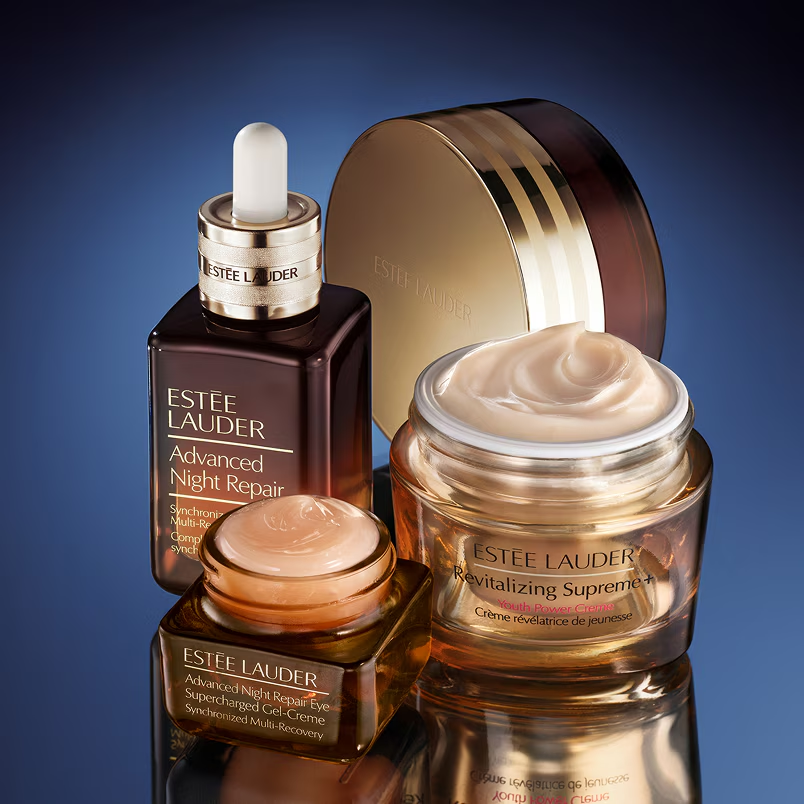
Talks were first confirmed publicly on March 23, 2026. The proposed structure was largely share-based, combining Estée Lauder’s 30-brand skincare and makeup empire with Puig’s fragrance-forward portfolio of Jean Paul Gaultier, Carolina Herrera, Rabanne, Nina Ricci, Charlotte Tilbury, and Byredo. Combined estimated revenues: just over $20 billion, which would have ranked it the largest premium beauty player globally, ahead of L’Oréal in the prestige segment.

The strategic case had genuine logic. Puig’s fragrance strength and European heritage would complement Estée Lauder’s skincare dominance and U.S. distribution muscle. Puig’s explosive APAC growth (21.7% like-for-like in 2025) aligned with Estée Lauder’s own China ambitions. Both companies are family-controlled, which, in theory, should make governance alignment easier.

Estée Lauder Puig
Annual Revenue (approx.) ~$14.3B ~€4.4B (record FY2025)
Key Categories Skincare, Makeup Fragrance, Makeup
Flagship Brands La Mer, MAC, Tom Ford Beauty, Jo Malone Charlotte Tilbury, Carolina Herrera, Byredo
Largest Region Americas EMEA (55% of revenue)
APAC Growth (2025) Double-digit China growth +21.7% LFL
Control Structure Lauder family Puig family

Combined entity would have been the world’s largest premium beauty group by revenue

Why It Collapsed

Three forces killed the deal, and they compounded each other.

First: Charlotte Tilbury. Bloomberg reported that a change-of-control clause embedded in Tilbury’s 2020 sale agreement to Puig created a financial complication that could not be resolved. Tilbury retains a 21.5% stake in her eponymous brand, with Puig contractually obligated to buy it out in tranches between 2026 and 2031. Any ownership change at the Puig parent level could trigger renegotiation of those terms, and Tilbury’s compensation demands in relation to any such change reportedly became an obstacle. Sources were clear: the Tilbury clause was not the only reason, merely the most visible one.

Second: family disagreements. Both the Lauder family and the Puig family are deeply involved in strategic decisions. Reuters reported that fundamental disagreements between the two controlling families, over governance, brand hierarchy, and the post-merger power structure, were the primary driver of collapse. Two proud, multi-generational families trying to agree on who runs a combined $40 billion house is not a simple boardroom negotiation. One analyst at AJ Bell described it bluntly as ‘handbags at dawn.’

Third: Estée Lauder’s investors simply did not want it. EL shares dropped 7.7% when the talks were first confirmed in March, a clear market signal that shareholders viewed the deal as a distraction from the company’s ongoing turnaround. With net debt running at roughly five times EBITDA, and a restructuring programme that has grown to $1.5–$1.7 billion in projected pre-tax charges, including plans to cut between 9,000 and 10,000 positions, layering in a massive share-based acquisition was a balance sheet stretch that few analysts supported.

Where Each Company Stands Now

Estée Lauder exits the episode in stronger-than-expected shape. Its Q3 FY2026 results (period ending March 31, 2026) showed net sales up 5% to $3.71 billion. The company raised its full-year guidance to approximately 3% organic growth and an adjusted operating margin of 10.7–11%, with EPS guidance upgraded by 56–62% year-over-year. Management is executing the Beauty Reimagined and One ELC operating model with increasing conviction. Piper Sandler initiated with Overweight and a $95 target. Portfolio rationalisation is also actively underway, with final bids in for Too Faced, Smashbox, and Dr. Jart+.

Puig faces a harder road. Its shares fell 15% on the day, the worst single-session move since its 2024 IPO, reflecting market disappointment that a deal many investors saw as the company’s route to scale and valuation re-rating is now off the table. EMEA remains 55% of its revenue, Charlotte Tilbury is both its star asset and its most complicated governance liability, and niche fragrance, despite strong fundamentals, remains under-distributed in key markets like China. New CEO Jose Manuel Albesa has a standalone growth strategy to execute, but without the Estée Lauder scale, Puig competes alone against L’Oréal, LVMH, and a resurgent Estée Lauder.

The Bigger Industry Signal

The collapse illustrates a structural truth about mega-mergers in prestige beauty: brand equity is built on founder identity, story, and heritage, and those things resist standardisation at the corporate level. Charlotte Tilbury is not simply a SKU in a portfolio; she is a contractual force of nature with personal leverage over any acquirer. The fragrance market’s reliance on niche founders and creative directors means M&A in this sector will consistently produce complications that spreadsheets cannot model.

For investors, the episode is a case study in reading market signals. The market told Estée Lauder shareholders the answer in March. It took until May to make it official

TAGGED:
Share This Article
Follow:
Jeanel Alvarado is a marketer and retail strategist, leveraging 15+ years of cross-disciplinary expertise in retail, e-commerce, technology, consumer and shopping trends. She is the former Senior Managing Director of the School of Retailing at the University of Alberta. Jeanel’s insights appear in Nasdaq, Entrepreneur, Fortune, TIME, and the US Chamber of Commerce, among others, with recurring commentary on top retailers and brands for financial markets, consumer insights, shopping trends, tech Innovation, and the luxury sector.