



Fashion Week concentrates something independent designers spend years trying to earn: the attention of buyers, editors and people who can carry a collection into the wider market.
In September 2026, several of the most visible retail names used that same attention for a different purpose. Their shows and activations gave audiences a clear next step inside the retailer’s own business.
At London Fashion Week, eBay and H&M were part of the official programme. Around New York Fashion Week, Gap Inc. built an Encore membership activation around access to designer shows. Together, they show how Fashion Week is becoming a shopping channel, a stage for a retailer’s own collections and a loyalty benefit.
That does not mean mass-market companies took places away from emerging designers. The public schedules do not establish that. It does mean the central commercial question has changed: when a larger brand hosts the moment, what does the designer receive beyond being seen?
Three events, three different customer paths
| Fashion Week activity | What the audience can do next | Primary destination |
|---|---|---|
| eBay Endless Runway | Buy selected pre-loved looks during the live show | eBay Live |
| H&M London show | Shop the first autumn drop and Atelier pieces that night | H&M online |
| Gap Inc. Encore at NYFW | Redeem member access to shows and experiences | Encore membership |
The distinction matters because the word “participation” can make these arrangements sound interchangeable. They are not. One sells secondhand pieces, one sells its own collection, and one sells the value of membership through access.
eBay: the runway becomes marketplace inventory
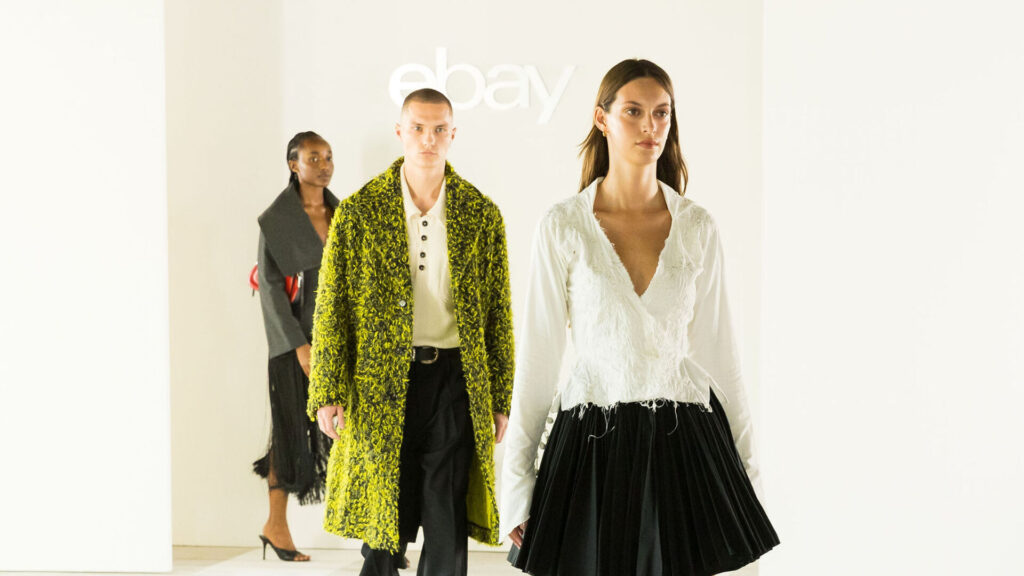
eBay’s Endless Runway offered the most direct link between a look and a transaction. Contributors including designers Charles Jeffrey and Giles Deacon supplied pieces from their wardrobes and creative worlds. The looks were styled by eBay’s team and made available to buy in real time through eBay Live. eBay said proceeds from the live sales would support Central Saint Martins’ Fashion Fund.
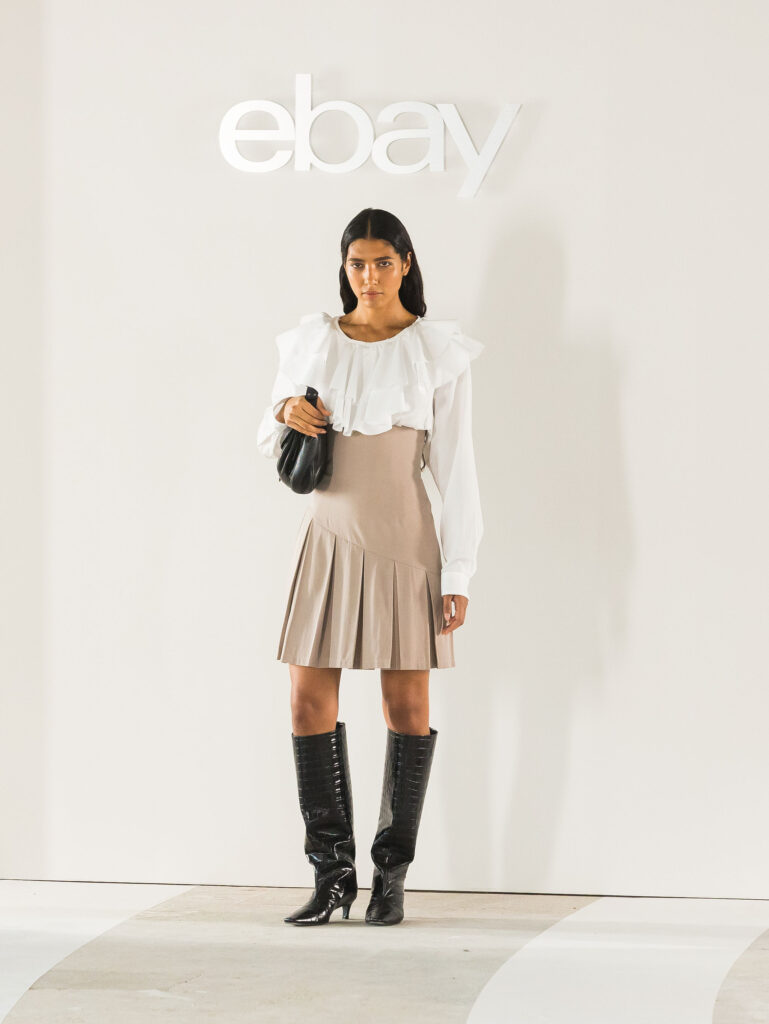
This is a concrete consumer offer and a concrete form of support for fashion education. But the audience was buying selected pre-loved items, not the contributors’ new collections. The event demonstrates eBay’s ability to turn a runway into a live marketplace; it does not, on the disclosed evidence, show whether participating designers gained new stockists, orders or customers for their own labels.
The visual hierarchy makes the strategic play easy to see. The designer’s item gives a look its character, while the eBay name and checkout give the audience a place to act. That may introduce people to the contributor, but the transaction and its immediate customer journey belong to the marketplace.
H&M: spectacle leads to its own assortment
H&M used its official London slot differently. Its show with Nick Knight and SHOWstudio combined runway, performance and interactive imagery around H&M’s autumn collection, Studio and Atelier lines. The company said its first autumn womenswear drop and Atelier menswear pieces became available through H&M’s online channels that same night. The show report makes that route from content to H&M product explicit.
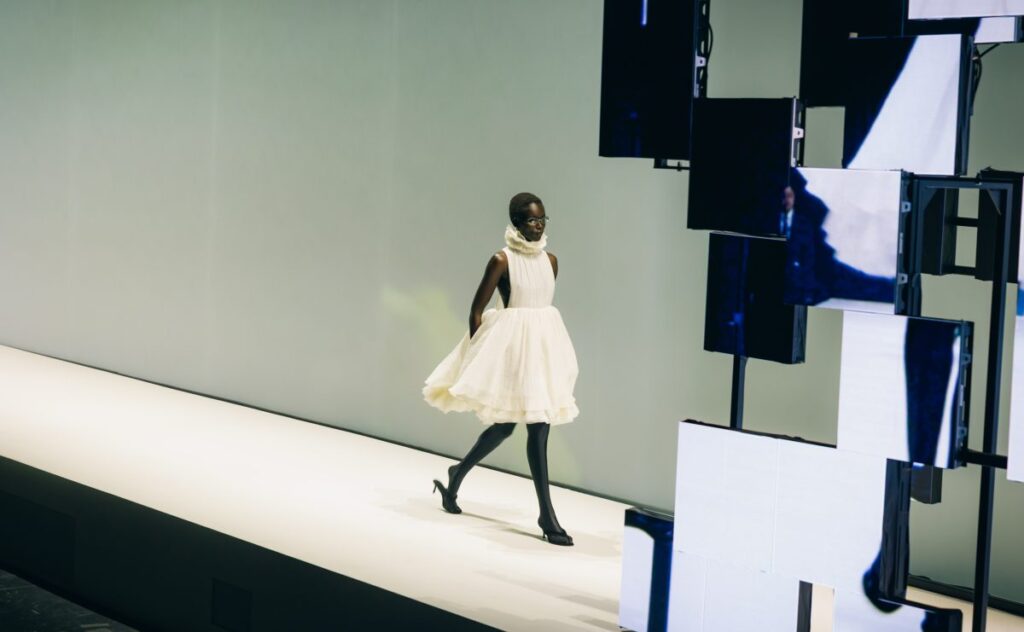
This was not a showcase of independent designers under an H&M banner. It was a retailer staging and selling its own design work with creative collaborators. The benefit to H&M is therefore easier to identify than any benefit to a separate label: the show can elevate its fashion image while sending interest toward merchandise already in its distribution system. That is a strategic interpretation of the format, not a claim about measured sales from the show.
Gap Inc.: designer access becomes a membership benefit
Gap Inc. did not position Encore as a Gap runway collection. Its NYFW programme offered members opportunities to attend shows by Alice + Olivia, Grace Ling, Kim Shui, KidSuper and Sandy Liang, along with other designer and entertainment experiences. Members could redeem access through Encore across the group’s apps and websites. Gap’s announcement describes access to those shows; it does not say their runway collections were sold by Gap, Old Navy or Banana Republic.
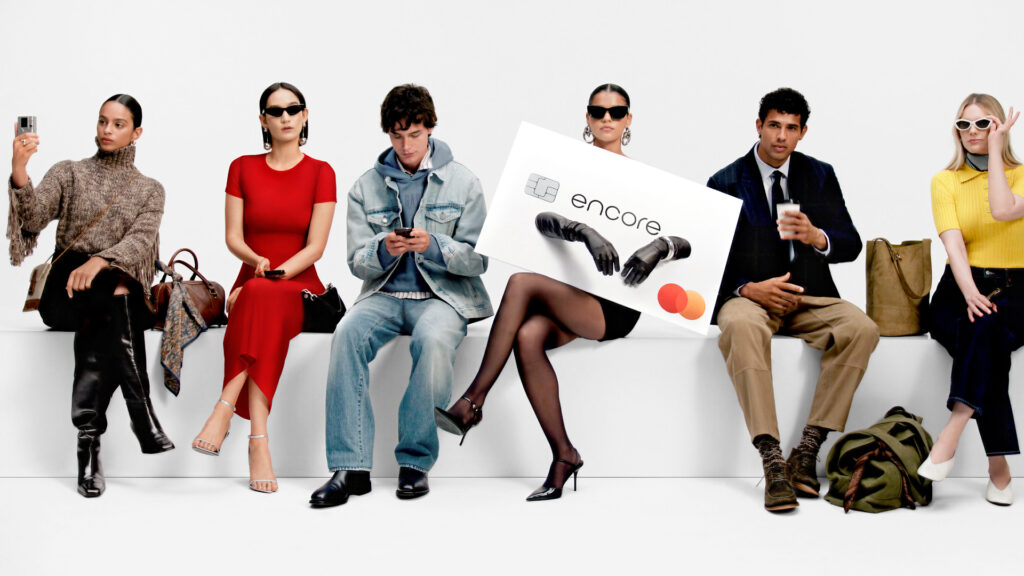
That makes the immediate business objective clearer: give customers another reason to join, engage with and value Encore. For the participating designers, an additional audience may be useful. But the announcement does not report whether member attendance led to buyer appointments, wholesale orders, direct sales or sustained discovery for their labels.
Gap Inc. has also shown what a more explicit retail partnership looks like. During the same September period, Banana Republic launched a separate La Ligne collaboration with Encore early access and availability in selected stores and online. That was a defined product and distribution arrangement. It should not be confused with member access to other designers’ NYFW shows.
Does the larger name take the spotlight?
In the materials the audience is asked to follow, the large company has the most obvious next step: shop H&M, buy on eBay Live, or redeem through Encore. The designers may be named, photographed and introduced to new people, but their route to a customer is less consistently built into the experience.
That is why the larger name is likely to dominate the takeaway. We do not have consumer-recall research from these events, so that is an interpretation of their branding and customer paths, not a measured recall result.
It would also be too simple to call retailer involvement a loss for designers. eBay’s stated donation to Central Saint Martins is a tangible benefit to the talent pipeline. Gap’s programme gave members access to named designers.
The British Fashion Council continued to programme emerging NEWGEN recipients alongside major houses and retail partners. The problem is not the presence of a mass retailer by itself; it is the lack of a visible bridge from the retailer’s audience to an individual designer’s business. The official London schedule shows both parts of that ecosystem.
What a stronger bargain would make visible
If a retailer says its Fashion Week presence supports designers, there are more useful things to show than audience size alone:
- A prominent path from the event to each designer’s own collection, stockists or store.
- Whether the retailer is buying, distributing or commissioning product—or only providing access and exposure.
- Any disclosed designer compensation, scholarship support or share of sales.
- Follow-on buyer meetings, wholesale orders or qualified referrals where designers agree to share them.
Those measures would not make every activation a direct-sales event. They would clarify what each party is trying to achieve and who receives value after the cameras leave. Our analysis of London Fashion Week buyer attendance shows why the industry audience still matters; attendance at the week, however, cannot by itself prove an order for any one designer.
Fashion Week can be broader and more accessible without becoming a retailer-only stage. The current examples show that major companies have built clear paths from the spectacle back to their own businesses.
The next test is whether the designers who give the week its creative reason to exist can point to an equally clear path forward.
Featured image: eBay Endless Runway 2026. Image: eBay.